


Brutalism has long been misunderstood. To many, the word evokes images of stark government complexes or cold university buildings -hulking masses of raw concrete that critics dismiss as severe or lifeless. But to skateboarders, Brutalism isn’t just an architectural style; it’s an invitation. The same raw concrete forms that once represented civic ambition have quietly become the world’s most democratic playgrounds. Skateboarding and Brutalism share a mutual language of edges, planes, and kinetic possibility, and nowhere is this relationship more evident than in the rise of the skatepark as a living Brutalist monument.
The Concrete Connection
Brutalism’s defining characteristic—béton brut, or raw concrete—was once prized for its honesty. Architects like Le Corbusier and Alison and Peter Smithson celebrated the unadorned surface, believing that structure should reveal itself without cosmetic cladding. Skateboarders, decades later, found a kindred spirit in those same materials. A smooth slab of poured concrete offers speed, friction, and resilience. Its durability turns every ledge, bank, and stair set into an open canvas for movement.
What architects conceived as civic infrastructure—plazas, overpasses, amphitheaters—skaters transformed into organic skateparks. Brutalist buildings unintentionally offered perfect geometry: ledges at ollie height, rails that challenge balance, and wide staircases for endless lines. In cities from London to Los Angeles, these heavy concrete forms became unsanctioned proving grounds, a renegade network of functional sculpture.
From Found Space to Designed Space
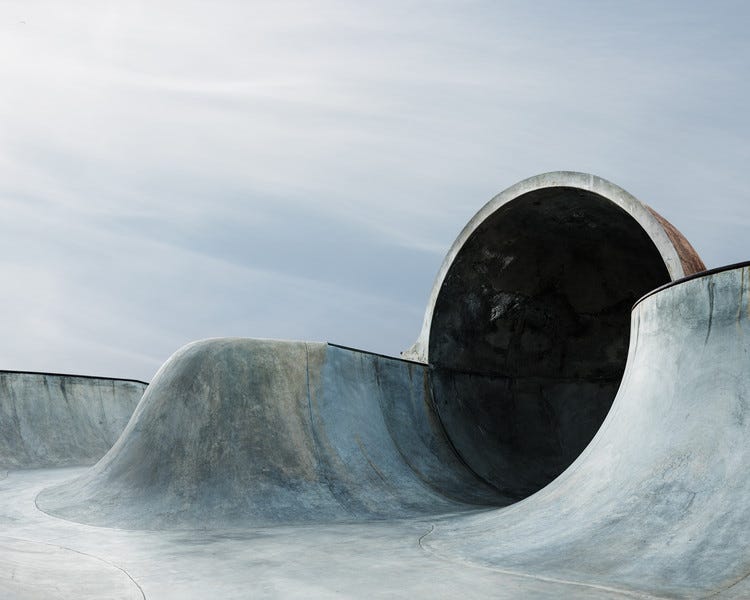
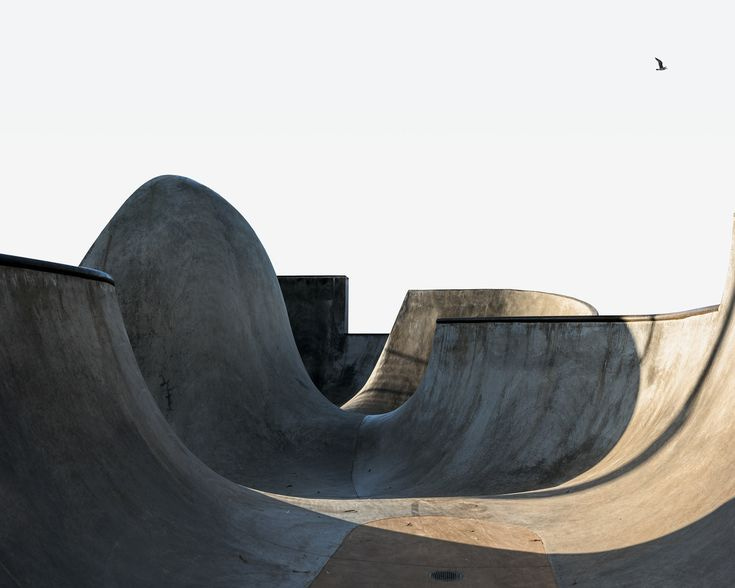
By the 1990s, municipalities caught on. The modern skatepark is, in many ways, an intentional homage to Brutalism. Designers borrow the same material palette and formal language: monolithic bowls, cantilevered ledges, and broad plazas poured entirely in concrete. The best parks feel like abstract civic sculptures—raw, grey, and geometric. They eschew decorative elements, instead emphasising flow and function.
Look at places like FDR Skatepark in Philadelphia or Ponds Forge Plaza in Sheffield: each is a labyrinth of concrete forms that appear almost improvised, yet every bank and quarter pipe speaks to careful choreography. Their appeal lies in honesty and adaptability. Nothing hides behind paint or veneer; it’s just concrete, gravity, and the skater’s imagination.
Culture in Motion
Skateboarding culture amplifies Brutalism’s democratic ethos. A skatepark is open to anyone with a board and a willingness to fall. There’s no prescribed use or single correct line—just as Brutalist architects once sought to create flexible spaces for the public, skaters interpret the terrain on their own terms. The aesthetic is raw and unapologetic: scraped surfaces, chipped edges, layers of graffiti marking each attempt and triumph.
Even the soundscape resonates. The sharp pop of a kickflip or the grind of trucks on a ledge becomes a percussive score against concrete’s natural reverb. These sonic textures are integral, turning the park into a living instrument—an urban drum where wheels and metal meet stone.
Why It Matters Now
In a design world awash with polished Instagram minimalism, skatepark Brutalism offers a counterpoint: authenticity. It’s proof that beauty can be heavy, that texture matters, that public space thrives when left unpolished. For architects, it’s a reminder that the most loved environments aren’t always the most manicured. For skaters, it’s a love letter to concrete—a material that asks for nothing but gives endless possibility.
Brutalism’s renaissance isn’t about nostalgia; it’s about relevance. Skateparks show that what was once labeled harsh can feel liberating. In the sweep of a bowl or the edge of a ledge, we find freedom in weight, elegance in mass, and joy in the simplest of materials. Skatepark Brutalism isn’t just architecture—it’s movement made visible, a testament to the enduring allure of concrete in motion.